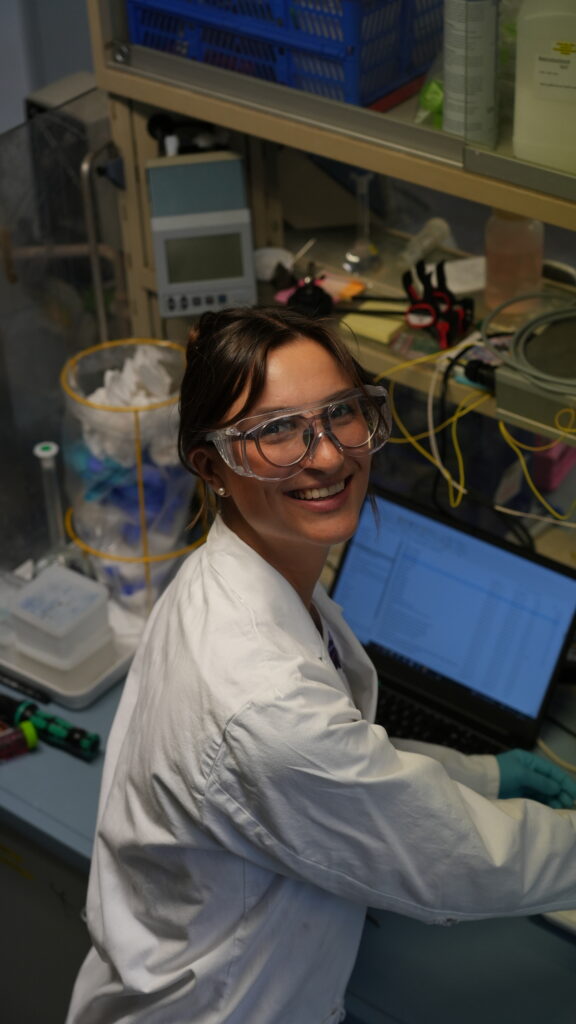
Zita Brejwo is usually among the first to arrive at the lab. She enjoys the quiet and solitude of those early hours before the day gets busy. Brejwo works closely with Thilo Reiter, another PhD researcher in the Electrochemical Energy, Catalysis and Materials Science group at ASTERISK partner TU Berlin, in Germany.
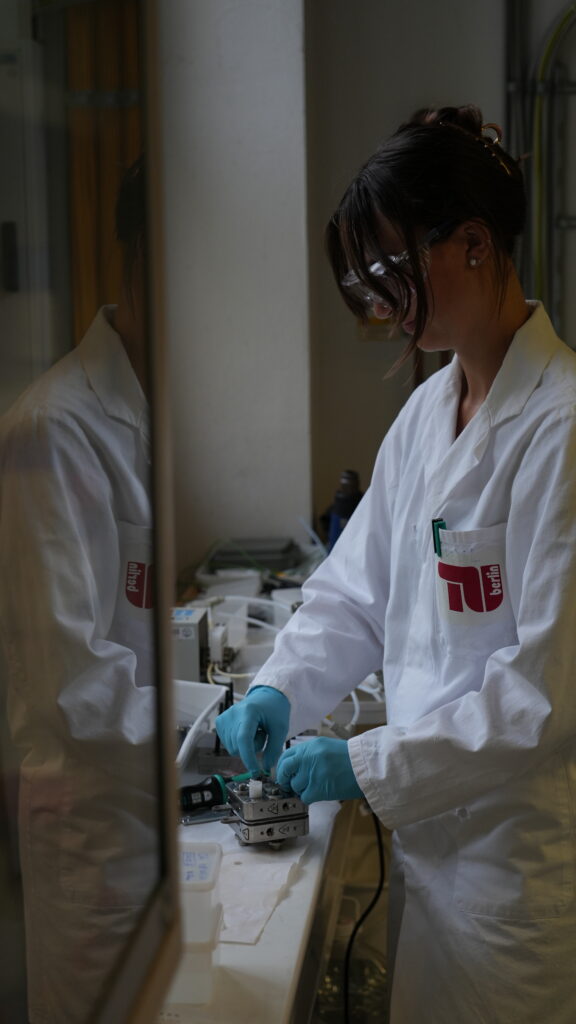
Most days begin at the testing station, where Brejwo prepares the membranes by soaking them in an alkaline solution before assembling the electrochemical cell. Once the setup is ready, she carries out electrochemical measurements to evaluate the performance of the different components within the electrolyser. Whilst testing the electrochemical cells, they still have time to review the previous day’s data or catch up on administrative tasks.
For Brejwo, a chemist’s job strikes the perfect balance between practical and theoretical work. “I enjoy the hands-on experimental work in the lab and observing the results of my work,” she says. “But afterwards, I always have time to sit down, write up my ideas, review the data and read up on relevant research.”
It was thanks to a teacher in her childhood that she decided to study chemistry. For her, it was clear: “She was an incredibly inspiring person who made us truly enjoy her classes.” From that moment on, her path in science was set.
Now, as a PhD candidate in electrochemistry, Brejwo cannot help but apply her expertise to daily life. After all, chemistry is all around: “It might sound silly, but when I get groceries or, let’s say, I want to buy some shampoo, I inevitably check the label to see its [chemical] composition.”
Curiosity is an essential quality for any scientist, as is perseverance, especially in European projects like ASTERISK, which focus on groundbreaking ideas.
The TU Berlin team is devoting a significant amount of time and effort to testing our electrolyser and comparing its performance with those of commercial brands. The lab receives all of the electrolyser components, such as catalysts, membranes and electrolytes, from other project partners to test their efficiency in a flow cell and establish a benchmark for our final design.
For Brejwo, the biggest challenge of working with seawater electrolytes lies in the corrosion caused by chlorine-containing species. “We want to produce as much oxygen and hydrogen as possible without triggering side reactions that form chlorine gas and hypochlorite, which can be highly corrosive to our electrolyser,” she says. This is why perseverance is key; only rigorous testing can ensure reliable results.
A scientific education tends to instil a sceptical, critical mindset. We are constantly questioning everything, which enables us to make progress. Outside the laboratory, this has a clear consequence: we can become more responsible consumers.
It might not seem like a huge shift; after all, we are just a drop in the ocean of humanity. Yet, without those drops, the ocean would not exist.
“Although nobody is perfect, I think we are all making small changes in our daily lives. For instance, I don’t have a car and cycle to work, but it goes beyond that,” she says. Since she started working in electrochemistry, Brejwo views sustainability as a holistic system. “We must start thinking not only about the products we buy, but also about everything behind them – where they come from, how they’ve been manufactured, what their supply chain is like and whether fair processes have been followed from a social perspective,” she explains. “In that way, we can make more conscious choices and help shape a better future. Or, at least, avoid leaving a negative impact on the world.”
Seawater is a cornerstone of ASTERISK. Naturally, we wondered what emotions the ocean evokes in those who spend part of their lives working with this element.
“We can make more conscious choices and help shape a better future.”
For Brejwo, the sea is powerful and fierce. “I was born in the Netherlands and spent my early years there, so my parents used to take me to the North Sea. I remember the massive waves and the very strong winds. It certainly isn’t a calm sea. It’s powerful, harsh, and cold – an image that has stayed with me and is what I picture whenever I think of the sea.”
At the same time, the researcher sees the ocean as a global connector. “It is what unites the whole world, so, in a way, it connects us all,” she concludes.