

“Like many transformative energy transitions before it, the clean hydrogen sector has moved through a familiar arc: from early enthusiasm and bold announcements, through a necessary period of consolidation, and now into the early stages of a genuine commercialisation phase.”
So begins “State of the clean hydrogen valleys sector 2026,” a report by the Clean Hydrogen Partnership (CHP) in collaboration with the global initiative Mission Innovation. These words and the idea they express belong specifically to Valérie Bouillon-Delporte, Executive Director of the CHP, the organisation co-funding ASTERISK alongside the European Union.
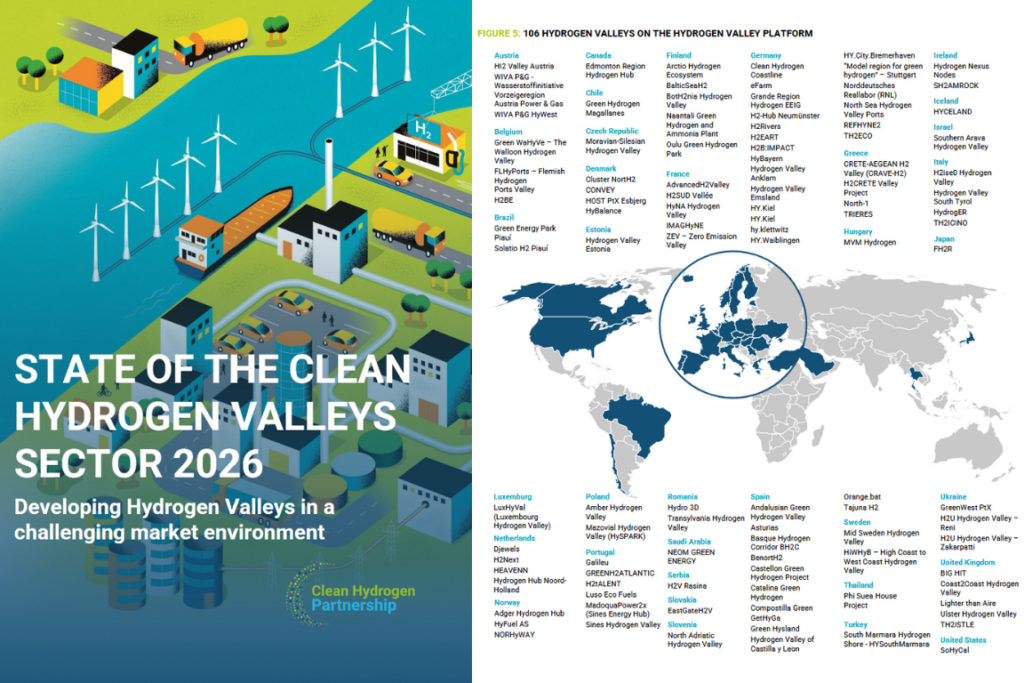
Spanning over 50 pages, the study examines the past, present, and future of hydrogen valleys from a global perspective, with a strong focus on Europe. As the report itself points out, 91% of these platforms are in the European region.
But let’s start at the beginning: what exactly is a hydrogen valley, and what can we learn from this latest CHP report?
At their core, hydrogen valleys are ecosystems designed to integrate the renewable hydrogen economy. They bring together green hydrogen production, storage, and distribution on a single, local platform to facilitate the use of this clean energy use.
Their applications vary from powering heavy-goods transport to decarbonising energy-intensive industries. In all cases, the valleys require one essential ingredient: full collaboration between investors, businesses and institutions.
Key points from the report
Europe views these energy ecosystems as essential. The 2024 European Commission staff working document, Towards a roadmap for accelerating the deployment of Hydrogen Valleys across Europe: challenges and opportunities, sets out the aspirational target of having at least 50 hydrogen valleys under construction or operational across Europe by 2030.
However, the latest figures revealed by the CHP are far more encouraging. The H2V Platform identifies 106 hydrogen valleys worldwide. Europe leads the way, hosting 91% of these platforms following by the Americas at 5%, the Middle East and the Asia-Pacific region, both at 2%, meaning reality is already outstripping original forecasts for 2030. According to the study:
“This concentration is underpinned by a strong enabling hydrogen policy framework the EU Hydrogen Strategy (2020), the REPowerEU Plan (2022), the Renewable Energy Directive III (RED III) (2023) and the subsequent delegated acts on hydrogen that simultaneously reinforces both hydrogen demand and supply, complemented by the active promotion of the Hydrogen Valley concept by European institutions, including the Clean Hydrogen Partnership.”
In addition, the share of operational hydrogen valleys has doubled in just two years, rising from 9% in 2024 to 18% this year.
Room for growth
As Valérie Bouillon-Delporte explained at the beginning of the report, emerging technologies often follow a predictable path. Initial hype and overambitious goals give way to consolidation, a shift that has led to the stalling or cancellation of some early European projects.
In this latest report, and for the first time, the CHP conducted a market sentiment survey among hydrogen project developers in Europe. The results showed that, in the long term, respondents feel “confident or very confident” about the prospects for the hydrogen market.
In the short term, however, challenges remain. Delays affect 39% of projects, driven mainly by:
– Project feasibility analysis (39%),
– Supply chain issues (30%), and
– Insufficient funding (25%)
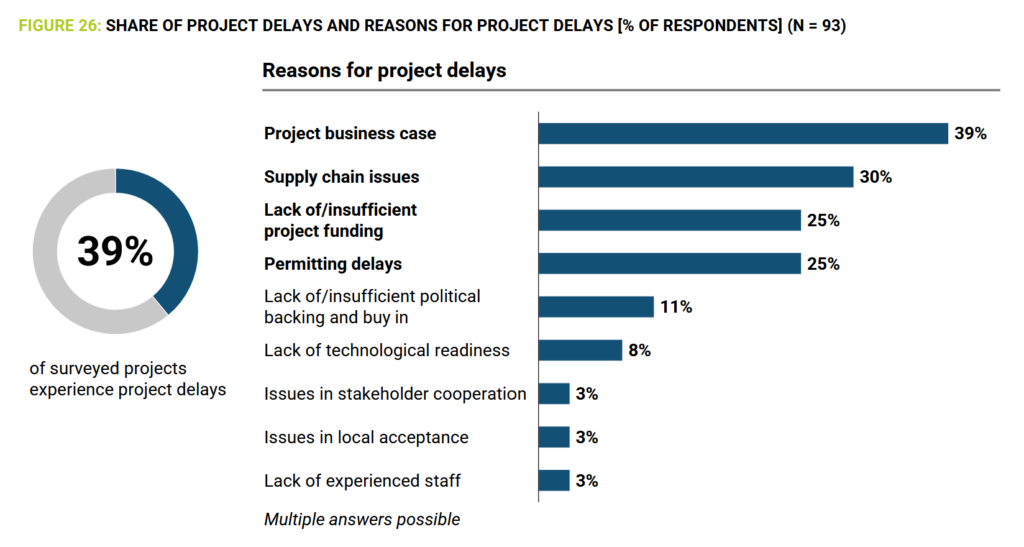
The survey concludes that reaching the final investment decision (FID), which arrives when funding is officially approved, remains the single biggest hurdle. Therefore, it is necessary to maintain a strong long-term belief in the green hydrogen industry and to translate this into a commitment to invest, supported by a secure regulatory framework.